Evaluation
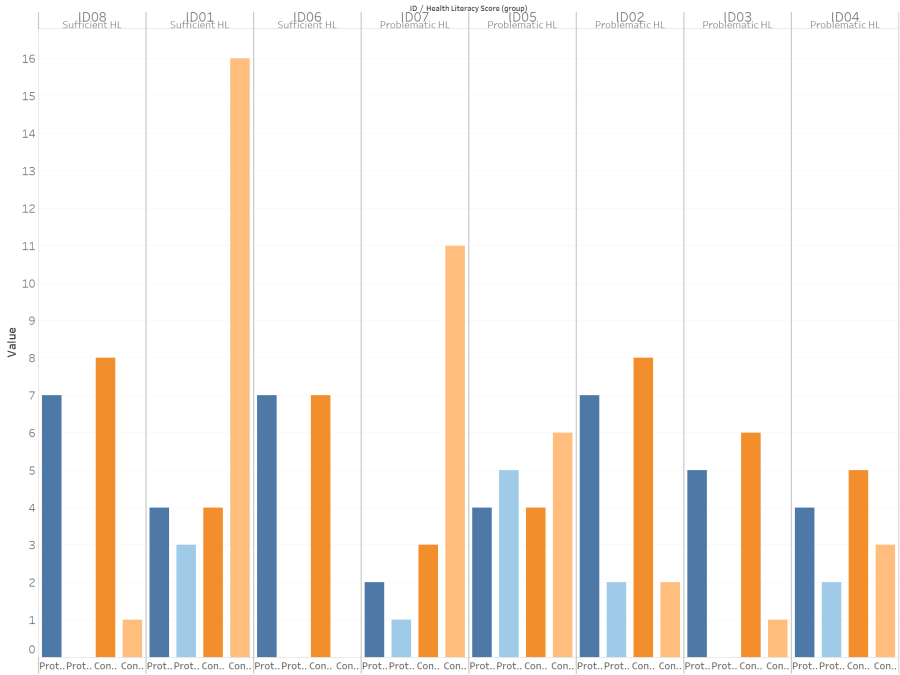
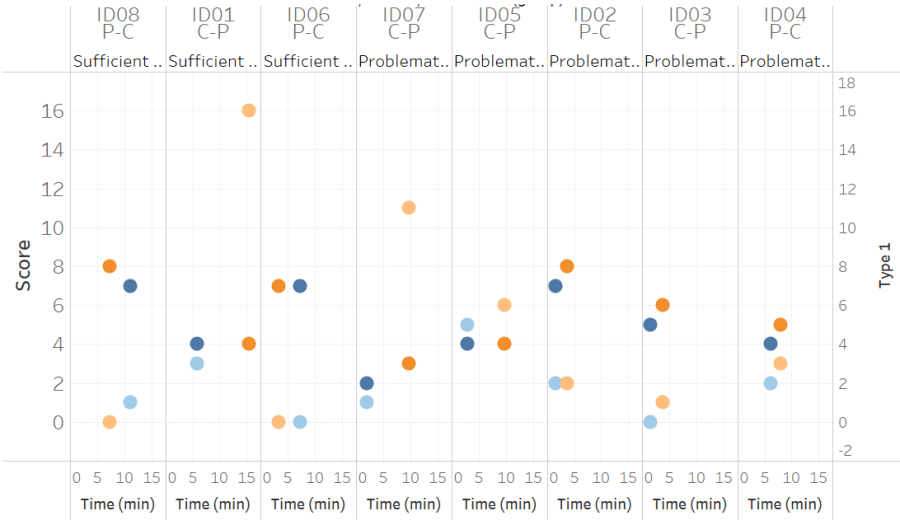
Summary Statistics
| Prototype | Control | |
| Score Median | 4.5 | 5.5 |
| Score Mean | 5 | 5.625 |
| Score Std Dev | 1.852 | 1.923 |
| False Positives Median | 1.5 | 2.5 |
| False Positives Mean | 1.625 | 5 |
| False Positives Std Dev | 1.768 | 5.707 |
| Health Literacy Score | Health Literacy | |
| Median | 11.5 | Problematic |
| Mean | 11.75 | |
| Std Dev | 2.712 |
| System Usability Scale | |
| Score Median | 70 |
| Score Mean | 68.75 |
| Score Std Dev | 6.547 |
Proposed Guidelines
Methodological & Design Guidelines

Methodological Guideline 1: Understanding and Designing for Stakeholders • Identify and design from the perspective of the most vulnerable stakeholder and prioritize those needs when incorporating other stakeholder’s requirements. 
Methodological Guideline 2: Data Provenance • Trace the production of data to understand the shortcomings of its creation and always maintain a critical attitude to what the data should represent 
Design Guideline 1: Supporting Health Literacy • Support automation by using a controlled vocabulary, such as a clinical data ontology, to streamline the data capture process. 
Design Guideline 2: Prioritizing Interactivity and Visual Feedback • Accommodate the health consumer’s health literacy through visual mapping of the controlled vocabulary to facilitate interaction and visual feedback.
Icons from the Noun Project
Please rate my project!
References
[1] NIH. (2016). The Cost of Sequencing a Human Genome. Retrieved from https://www.genome.gov/27565109/the-cost-of-sequencing-a-human-genome/
[2] Thomas, J. J., & Cook, K. A. (2005). Illuminating the path: The research and development agenda for visual analytics. IEEE Computer Society, 184. https://doi.org/10.3389/fmicb.2011.00006
[3] Hasso Plattner Institute of Design at Stanford University. (2020). Get Started with Design Thinking. from https://dschool.stanford.edu/resources/getting-started-with-design-thinking
[4] Nielsen Norman Group. (2020). Design thinking 101. Retrieved March 16, 2020, from https://www.nngroup.com/articles/design-thinking/
[5] Pink, S., & Morgan, J. (2013). Short-term ethnography: Intense routes to knowing. Symbolic Interaction, 36(3), 351–361. https://doi.org/10.1002/symb.66
[6] Millen, D. R. (2000). Rapid ethnography: Time deepening strategies for HCI field research. Proceedings of the Conference on Designing Interactive Systems: Processes, Practices, Methods, and Techniques, DIS, 280–286.
[7] Geysler, C., & Swarts, J. (2019). Coding Streams of Language. Techniques for the Systematic Coding of Text, Talk, and Other Verbal Data. Boulder: University Press of Colorado. https://doi.org/10.1017/CBO9781107415324.004
[8] Rittel, H. W. J., & Webber, M. M. (1973). Dilemmas in a General Theory of Planning. Policy Sciences, 4, 155–169. https://doi.org/10.1080/01636609209550084
[9] Buchanan, R. (1992). Wicked Problems in Design Thinking. Design Issues, 8(2), 5–21. https://doi.org/10.2307/1511637
[10] Kaptelinin, V., & Nardi, B. A. (2006). Acting with technology: Activity theory and interaction design. MIT Press.
[11] Robinson, P. N., & Mundlos, S. (2010). The Human Phenotype Ontology. Clinical Genetics, 77(6), 525–534. https://doi.org/10.1111/j.1399-0004.2010.01436.x
[12] Köhler, S., Vasilevsky, N. A., Engelstad, M., Foster, E., McMurry, J., Aymé, S., … Robinson, P. N. (2017). The human phenotype ontology in 2017. Nucleic Acids Research, 45(D1), D865–D876. https://doi.org/10.1093/nar/gkw1039
[13] Sorensen, K., Van den Broucke, S., Pelikan, J., Fullam, J., Doyle, G., Slonska, Z., … Brand, H. (2013). Measuring health literacy in populations: illuminating the design and development process of HLS-EU-Q. BMC Public Health, 13(1), 948. https://doi.org/doi:10.1186/1471-2458-13-948
[14] U.S. Department of Health & Human Services. (2020). System Usability Scale (SUS). Retrieved February 4, 2020, from https://www.usability.gov/how-to-and-tools/methods/system-usability-scale.html
[15] Bangor, A., Kortum, P. T., & Miller, J. T. (2008). An empirical evaluation of the system usability scale. International Journal of Human-Computer Interaction, 24(6), 574–594. https://doi.org/10.1080/10447310802205776
 Aldo A Barrera Machuca